
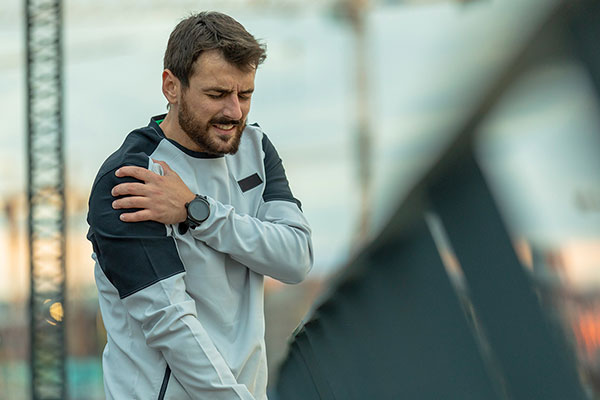
Advances in minimally invasive shoulder surgery are helping patients restore function, reduce pain, and return to the activities they love.
Shoulder pain can affect nearly every aspect of daily life, from reaching overhead and lifting weights to sleeping comfortably at night. For active individuals, athletes, and those who rely on their shoulders for work, a rotator cuff tear can be particularly frustrating.
Fortunately, rotator cuff surgery has evolved significantly over the past two decades. Today, arthroscopic rotator cuff repair allows orthopaedic surgeons to repair torn tendons through small incisions using specialized cameras, instruments, and advanced fixation techniques.
The goal isn't simply to repair a torn tendon. It's to restore shoulder function, promote tendon healing, preserve the native joint, and help patients return to an active lifestyle.
Understanding Rotator Cuff Tears
The rotator cuff consists of four muscles and their tendons that surround the shoulder joint. Together, these structures stabilize the shoulder and help control arm movement.
Rotator cuff tears can develop from an acute injury, such as a fall or lifting incident, or gradually through repetitive use and age-related tendon degeneration.
Common symptoms include:
- Pain when reaching overhead or behind the back
- Shoulder weakness, particularly when lifting or rotating the arm
- Nighttime pain, especially when lying on the affected shoulder
- Difficulty with exercise, sports, or daily activities
- Loss of shoulder strength or mobility
Not every rotator cuff tear requires surgery. Physical therapy, activity modification, and other nonsurgical treatments can be effective, particularly for certain degenerative or partial-thickness tears.
However, surgery may be recommended for patients with acute traumatic tears, persistent pain or weakness despite appropriate treatment, or tears that threaten long-term shoulder function.
What Is Arthroscopic Rotator Cuff Repair?
Arthroscopic rotator cuff repair is a minimally invasive surgical procedure that uses a small camera, called an arthroscope, to visualize the shoulder joint and repair damaged tendons.
Rather than making a large incision to access the rotator cuff, the surgeon creates several small portals around the shoulder.
Through these portals, specialized instruments allow the surgeon to evaluate the tear, prepare the tendon and bone, and securely reattach the tendon to its natural insertion on the humerus.
The advantages of arthroscopic surgery include:
- Smaller incisions and less disruption of surrounding soft tissues
- Detailed visualization of the shoulder joint and rotator cuff
- The ability to identify and treat associated injuries, such as biceps or labral pathology
- Precise placement of sutures and fixation devices
- Potentially less early postoperative discomfort compared with more invasive approaches
Importantly, both arthroscopic and traditional open techniques can achieve excellent outcomes. The best surgical approach depends on the characteristics of the tear, the patient's needs, and the surgeon's expertise.
Modern Advances in Rotator Cuff Repair
Today's arthroscopic techniques go beyond simply stitching a torn tendon back into place. Modern repairs focus on restoring the tendon to its anatomic attachment while creating a stable environment for biological healing.
1. Advanced Suture Anchors and Fixation Techniques
One of the most important advances in arthroscopic rotator cuff repair has been the development of sophisticated suture anchors.
These small implants are placed into the bone and used to secure the torn tendon back to its original attachment site, known as the rotator cuff footprint.
Modern anchors may incorporate high-strength sutures, knotless fixation, and specialized materials designed to provide secure tendon fixation.
Single-row versus double-row repair
In a single-row repair, anchors secure the tendon along one row of fixation points.
Double-row and transosseous-equivalent techniques use additional fixation to compress the tendon against a broader area of bone.
Biomechanical studies have demonstrated advantages in footprint coverage and certain measures of repair strength with double-row constructs. Some clinical studies also suggest lower structural retear rates, particularly for larger tears.
However, double-row repairs do not consistently produce superior patient-reported outcomes for every tear.
The most appropriate construct depends on tendon quality, tear size, mobility, bone quality, and the ability to achieve a low-tension repair.
2. Knotless Rotator Cuff Repair
Knotless suture anchor technology has become increasingly popular in arthroscopic shoulder surgery.
Traditional repairs require surgeons to tie surgical knots to secure the tendon. Knotless systems allow sutures to be tensioned and fixed without bulky knots.
Potential benefits include more controlled suture tensioning, reduced knot-related irritation, and efficient construction of certain repair configurations.
The priority remains achieving secure fixation while protecting the tendon and preserving its blood supply.
3. Better Management of Complex and Large Tears
Not all rotator cuff tears are the same.
Some tears are small and relatively straightforward to repair. Others involve multiple tendons, significant retraction, poor tendon quality, or chronic changes in the surrounding muscles.
Modern arthroscopic surgery offers several strategies for addressing these more challenging injuries.
These may include:
- Margin convergence: Bringing together the edges of certain U-shaped or L-shaped tears to reduce tension before tendon fixation.
- Advanced tendon mobilization: Carefully releasing adhesions to improve tendon mobility and facilitate repair.
- Patch augmentation: Using a biologic or synthetic scaffold in selected cases to reinforce a repair or support tissue healing.
- Partial repair: Restoring portions of the rotator cuff force couple when complete anatomic repair is not feasible.
For certain irreparable tears, additional procedures such as superior capsular reconstruction or tendon transfer may be considered.
The key is tailoring the procedure to the patient's anatomy, functional demands, and long-term goals rather than using the same repair technique for every shoulder.
4. Biologic Augmentation: Supporting the Healing Process
One of the greatest challenges in rotator cuff surgery is not necessarily securing the tendon during surgery. It is achieving durable tendon-to-bone healing afterward.
Even when a repair is technically successful, biological healing takes time and may be influenced by age, tendon quality, tear size, smoking, metabolic health, and other factors.
This has led to growing interest in biological augmentation.
Bioinductive implants
Bioinductive collagen implants are designed to support new tissue formation and may be used in selected partial- or full-thickness rotator cuff tears.
Early clinical research has demonstrated promising findings in tendon thickness and structural outcomes for certain applications. However, indications, long-term comparative effectiveness, and cost-effectiveness continue to be studied.
Platelet-rich plasma (PRP)
PRP uses a concentration of platelets obtained from the patient's own blood.
Some studies suggest that certain PRP preparations may reduce structural retear rates after rotator cuff repair, but results vary based on the formulation, application method, and patient population.
Biologic treatments are best considered potential adjuncts rather than substitutes for a well-executed mechanical repair and an appropriate rehabilitation program.
Why Tendon Healing Matters
A successful rotator cuff repair involves two important components:
- Mechanical fixation Securely reattaching the tendon to bone.
- Biological healing: Allowing the tendon to form a durable attachment over time.
Although modern implants can provide strong initial fixation, they cannot eliminate the biological time required for healing.
This is why postoperative rehabilitation must balance protecting the repair with gradually restoring mobility and strength.
Returning to heavy lifting or unrestricted activity too early can place unnecessary stress on the healing tendon.
Recovery After Arthroscopic Rotator Cuff Repair
Recovery is individualized based on the size of the tear, the quality of the tendon, the surgical technique, and the patient's activity goals.
A general recovery timeline may look like this:
Weeks 0–6: Protecting the repair
Most patients wear a sling for approximately four to six weeks, depending on the repair. Passive or assisted motion may begin during this period according to the surgeon's protocol.
Weeks 6–12: Restoring shoulder mobility
As healing progresses, rehabilitation typically emphasizes gradually restoring active shoulder motion and improving movement quality.
Months 3–4: Building strength
Progressive strengthening exercises are introduced or advanced when appropriate, focusing on the rotator cuff, shoulder blade stabilizers, and coordinated shoulder movement.
Months 4–6 and beyond: Returning to activity
Patients progressively return to higher-level activities as strength, mobility, and functional control improve.
Heavy labor, overhead sports, and demanding athletic activities may require six months or longer. Some patients continue improving for 9–12 months or more.
These timelines are general guidelines, not a substitute for an individualized rehabilitation plan.
Is Arthroscopic Rotator Cuff Repair Right for You?
Not every rotator cuff tear requires surgery, and not every tear benefits from the same surgical approach.
When evaluating a patient, I consider several important factors:
- Type of tear Is it partial-thickness or full-thickness?
- Size and retraction: How much tendon is involved, and how far has it moved from its attachment?
- Tendon and muscle quality: Is there significant degeneration, atrophy, or fatty infiltration?
- Symptoms: Is the primary concern pain, weakness, loss of function, or a combination?
- Activity demands: Does the patient participate in sports, perform physical work, or have other high-demand goals?
- Response to nonsurgical treatment: Have appropriate conservative options been explored?
For younger, active patients with acute traumatic tears, timely evaluation can be particularly important because some tears may enlarge or become more difficult to repair over time.
A personalized treatment plan helps determine whether continued nonsurgical management or arthroscopic repair offers the best opportunity for a successful outcome.
The Future of Rotator Cuff Surgery: More Precise, More Personalized
Modern rotator cuff surgery is moving toward a more individualized approach.
Advances in arthroscopic instrumentation, suture anchor technology, repair configurations, and biological augmentation continue to expand the options available to surgeons.
But technology alone does not determine success.
The best outcomes come from combining thoughtful patient selection, meticulous surgical technique, an understanding of tendon biology, and structured rehabilitation.
For patients who want to remain active, the ultimate objective is joint preservation: restoring function, protecting the shoulder, and supporting long-term musculoskeletal health.
Shoulder Pain Shouldn't Define Your Activity Level
If shoulder pain, weakness, or a known rotator cuff tear is keeping you from the activities you enjoy, a comprehensive evaluation can help clarify your treatment options.
At the Joint Preservation Center in Greenwood Village, Colorado, Dr. Catherine Logan specializes in sports medicine and joint-preserving procedures, including arthroscopic shoulder surgery.
Our approach focuses on understanding your injury, your goals, and the most appropriate treatment to help restore function and support long-term shoulder health.
Ready to take the next step?
Learn more about arthroscopic shoulder surgery or schedule a consultation with Dr. Catherine Logan.


